
Blog
Cold Chain Disposable Gloves: How to Choose Nitrile Gloves for Freezers and Low-Temperature Work (2026)
Fujian Jixiang E-commerce Co., Ltd
A practical guide to nitrile disposable gloves for cold chain logistics, cold storage and freezer work: how low temperatures change glove performance, what to check for flexibility and grip, and how to build a safe change routine.
Nitrile rubber gloves remain the default barrier material in cold chain logistics, cold storage warehouses and freezer food production - but low temperatures change how a glove performs, and most failures in cold rooms start with the wrong selection assumptions, not with the glove itself.
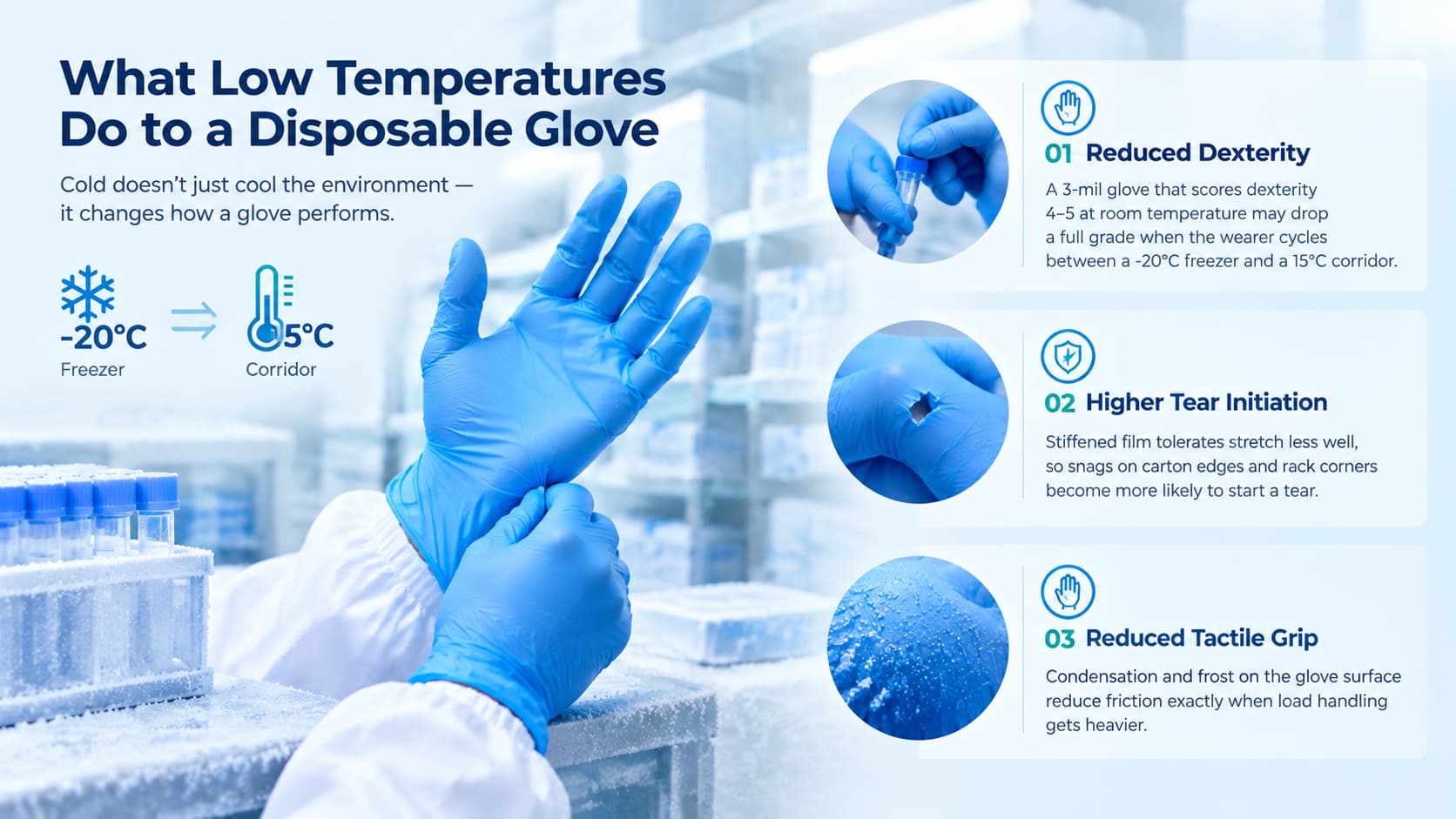
What Low Temperatures Do to a Disposable Glove
Nitrile rubber is a synthetic elastomer (acrylonitrile butadiene rubber), and like all elastomers its stiffness rises as temperature falls. Below roughly 0 C the polymer chain mobility drops, so a glove that feels soft and dexterous at room temperature can become noticeably stiffer at -18 C to -25 C. Flexing cycles that are harmless at 23 C can promote micro-cracking at freezer temperatures, especially around the knuckles and cuff roll.
Three practical consequences follow:
- Reduced dexterity: a 3-mil glove that scores dexterity 4-5 at room temperature may drop a full grade when the wearer cycles between a -20 C freezer and a 15 C corridor.
- Higher tear initiation: stiffened film tolerates stretch less well, so snags on carton edges and rack corners become more likely to start a tear.
- Reduced tactile grip: condensation and frost on the glove surface reduce friction exactly when load handling gets heavier.
Selection Criteria for Cold Chain Gloves
| Selection Factor | What to Check | Why It Matters in Cold Work |
|---|
| Material | Nitrile rubber, accelerator-free formulation for prolonged skin contact | Nitrile keeps flexible barrier integrity at low temperature better than PVC; latex is not always accepted in food plants |
| Thickness | 4-5 mil (0.10-0.13 mm) for freezer picking; 6-8 mil for mixed cold/outdoor tasks | Too thin stiffens and tears early; too thick loses the finger feel needed for carton marking and scanning |
| Textured fingertips | Fully textured or diamond grip fingertips | Compensates for frost and condensation film on handled surfaces |
| Cuff | Beaded cuff, long enough to tuck under insulated jacket sleeves | Prevents roll-down during repeated bending and reaching in racks |
| Compliance | Food-contact declarations (EU 1935/2004 or FDA 21 CFR 177.2600); EN 455 or ASTM D6319 for medical cold chain; EN ISO 21420 (formerly EN 420) as the general-requirements baseline | Cold chain work often mixes food handling with pharma distribution - the declaration must match the actual use |
Thermal Cycling: The Failure Mode Buyers Miss
The dominant stress in cold chain work is not constant cold - it is cycling. Workers move between freezer (-18 C to -25 C), chill rooms (0 C to 4 C) and ambient corridors many times per shift. Each transition produces condensation on the glove, and repeated flexing of a chilled, damp film accelerates fatigue. In practice this means the effective service life of a glove in a cold store is shorter than in ambient work, even when the glove shows no visible damage at the start of a shift.
A robust change routine therefore has three elements: replace gloves at defined intervals rather than on visible failure alone; inspect fingertips and thumb webbing during breaks; and never re-don a glove that has been removed - a fresh pair costs far less than a dropped or contaminated pallet.
Glove Selection by Cold Chain Task
| Task | Recommended Glove | Rationale |
|---|
| Freezer picking and order assembly (-18 C to -25 C) | 4-5 mil textured nitrile, changed every 2-4 hours | Balances flexibility for scanning and marking against barrier life under flexing cycles |
| Cold storage loading docks | 5-6 mil nitrile with fully textured palm | Higher abrasion exposure from pallets, cages and dock equipment |
| Food contact in chill rooms | Blue nitrile with food-contact declaration; metal-detectable variant where HACCP requires | Blue aids visual detection; detectable variants support foreign-body controls |
| Pharma cold chain (2-8 C) | Exam-grade nitrile per EN 455 or ASTM D6319, powder-free | Product-contact and documentation requirements apply alongside the thermal ones |
| Outdoor winter unloading | Pair disposable nitrile with insulated over-gloves; replace inner pair at breaks | Disposable film is not thermal protection - layering preserves both warmth and hygiene |
Common Mistakes to Avoid
- Treating thickness as the whole answer: beyond about 6 mil, extra thickness buys stiffness faster than it buys cold protection.
- Ignoring the ambient-to-freezer transition: most documented failures occur within the first 10 minutes after entering the freezer, while the glove is still damp from the corridor.
- Re-using removed gloves: re-donning transfers frost, condensation and contamination back to the hand and the product.
- Missing declarations: a food-contact claim must be supported by the migration test documentation, not by marketing copy.
Practical Takeaway
Cold chain glove programs fail on routine, not on material. Specify nitrile rubber with a texture and thickness matched to the temperature zone, confirm the food-contact or medical declaration for the real use case, and enforce timed replacement around thermal cycling. Buyers who write these three points into the specification sheet typically see fewer mid-shift breakages and lower total consumption, because gloves are retired on schedule instead of being stretched past their reliable life.
FAQ
Q: Are nitrile gloves safe to use in freezers?
A: Yes. Nitrile rubber retains its barrier properties at freezer temperatures, but it stiffens below about 0 C. Choose a texture and thickness matched to the task, and replace gloves on a timed schedule because thermal cycling shortens their effective life.
Q: What thickness works best for cold storage work?
A: For freezer picking, 4-5 mil (0.10-0.13 mm) textured nitrile offers the best balance of dexterity and tear resistance. For dock and mixed tasks, 5-6 mil holds up better against abrasion.
Q: Do gloves lose their food-contact compliance at low temperature?
A: No. The food-contact declaration (such as EU 1935/2004 or FDA 21 CFR 177.2600) applies to the material, not the temperature. But confirm the migration test documentation covers your actual conditions of use.
Q: Why do gloves break more often in cold rooms than in ambient areas?
A: Repeated transitions between freezer, chill room and corridor create condensation and repeated flexing of a chilled film. This fatigue effect means a shorter reliable service life than room-temperature work, even without visible damage.
Q: Can workers wear disposable gloves over or under insulated gloves?
A: Yes, layering is the recommended practice: a disposable nitrile glove against the skin or product for hygiene, with an insulated over-glove for warmth. Replace the inner disposable pair at breaks.